People suffering from chronic illness often find it difficult to explain what they are going through. How do I talk about my pain, lack of energy, exhaustion at the simplest tasks, with someone who has never experienced such a thing? How do I show them that the things they do easily are difficult for me?
The spoon theory is an easy way to demonstrate how a chronic illness can affect someone’s daily functioning. Invented by Christine Miserandino in 2003, in her essay The Spoon Theory, it has become a useful tool for many sufferers of chronic illness to describe what they are going through.
Miserandino came up with the idea to explain her experience of lupus to a friend when sitting in a diner. It has since come to be used by many in the “spoonie” community to talk about living with illnesses such as chronic fatigue, chronic pain, fibromyalgia, MS, other autoimmune diseases. Some have adopted the concept of the spoon theory for mental health, too.
How the Spoon Theory Works
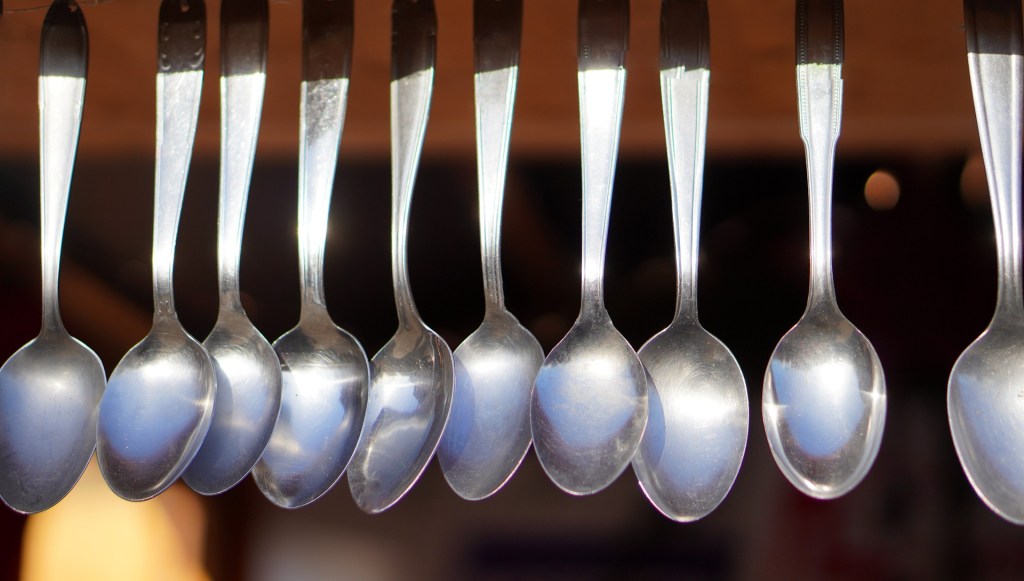
Each day you get a set of spoons. Spoons are your “units of energy” for the day.
You might use a spoon to brush your teeth. To take a shower. Get dressed. Do your hair. Make breakfast. Put on makeup. Travel to work.
Someone healthy will have lots of spoons. They get through these daily activities just fine. They never need to worry about running out of spoons, as most of these activities will hardly make any impact on their energy reserves. Taking a shower might be relaxing and a healthy person may even gain a spoon from it. Running to the bus is no big deal.
These same activities will look different from the perspective of someone with a chronic illness. They get given less spoons for the day. They may use them all up just getting things done in the morning. Then exhaustion hits.
To make things worse, some activities will cost more spoons than for other people.
Taking a shower may have a negligible impact on a healthy person’s energy level. For someone with chronic illness, taking a shower means dealing with finding the appropriate water temperature. It means lifting arms up to wash hair and keeping them elevated for a long period of time. It means taking clothing off and putting it back on, making uncomfortable movements and having fabric scratch your skin. All of these things can be painful, tiring, or both.
Counting spoons
Because of the limited amount of spoons we get, those of us with chronic illnesses need to be more mindful of what we can and cannot do. Sometimes that means making compromises between things like going out to the shops or making dinner. Cleaning up or answering emails. Sometimes it means having to cancel plans.
Often we need to plan in advance to make sure we don’t run out of energy.
As someone with chronic pain I would find that I could not plan several after work activities over the course of a week. Two evenings out in a row and I’d be broken.
If I know I am meeting a friend this evening I will try to take it easy earlier in the day so as to save my energy. If I try to clean the house and run errands, I know I will be exhausted by mid afternoon. Chronic illness sufferers often don’t respond too well to spontaneous plans because we are not prepared for them.
Remember that the energy we are talking about here is not just about physical energy. Many chronic illnesses, chronic pain included, have a relation to mental health. There is also a great amount of mental effort that can go into looking after our physical health, and this added mental load is also what keeps eating up our spoons.
It means having to consciously think about things most people don’t need to worry about. For a chronic illness sufferer it may mean having to plan ahead what to bring. Maybe they cannot travel without medication. Maybe they need to spend extra time getting ready, because their hands are shaky. Maybe they need to wear specific clothing that day because anything moderately fitted feels too tight and painful.
Saving spoons
Our spoon reserves are not equal each day. There are days when we get more spoons and we manage better than we do on other days. Sometimes we may seem to function perfectly fine, which can then make it difficult to understand why we claim to be so sick the next day. Health fluctuates and so does sickness.
What makes things even more complicated is that we can manage a little more than we should, if we really want to.
Say in the weekend I would plan to do cleaning and grocery shopping on one day. I was planning to spend the evening resting and recuperating. A friend texts me spontaneously, asking to meet up that same evening. . Many people would find it difficult to understand why I wouldn’t want to go out. But you have no plans! they would say.
And that’s because I could not physically manage having so many plans that same day. It is not just me being an antisocial introvert 😉
Sometimes I would really love to go out and respond to that spontaneous invite. I will muster my energy and go ahead with it, knowing that tomorrow I will feel the consequences. I am borrowing from tomorrow’s spoons, and tomorrow I will have less to go by.
This is how we can seem to have more energy than we really do. Borrowing from tomorrow’s spoons is an emergency resource we do because we are people who want to prove that we can. We have lots of willpower and we want to be bold and ambitious and amazing. We are willing to deal with the consequences the next day, which might mean lying in bed all day or crying in pain. Borrowing from another day’s spoons is not sustainable, and that is why we like to save our spoons and keep some in reserve just in case.
Running out of spoons
Being able to do so many things on some days and not on others may come across as inconsistent to someone on the outside. This does not help with our understanding of invisible illness.
Many of us, sick or healthy, know what it is like to be exhausted from doing too much – walking too long, working too long, carrying something too heavy. Many of us have had temporary bouts of illness such as the flu that have made everyday activities exhausting. We know what it’s like to sit around at home and feel too tired to do anything really except eat and go to sleep.
Let’s remember that sufferers of chronic illness experience this much more frequently and strongly than a healthy person would.
Let’s make sure we know what it means when someone tells you they are running out of spoons. They are not being lazy, flaky or noncommittal. They are unwell.
Did you enjoy this post? I will write more about invisible illnesses soon – stay tuned! Subscribe so you don’t miss it.
 Raw Rebellion
Interesting theory! Let’s try to save spoons!
LikeLike