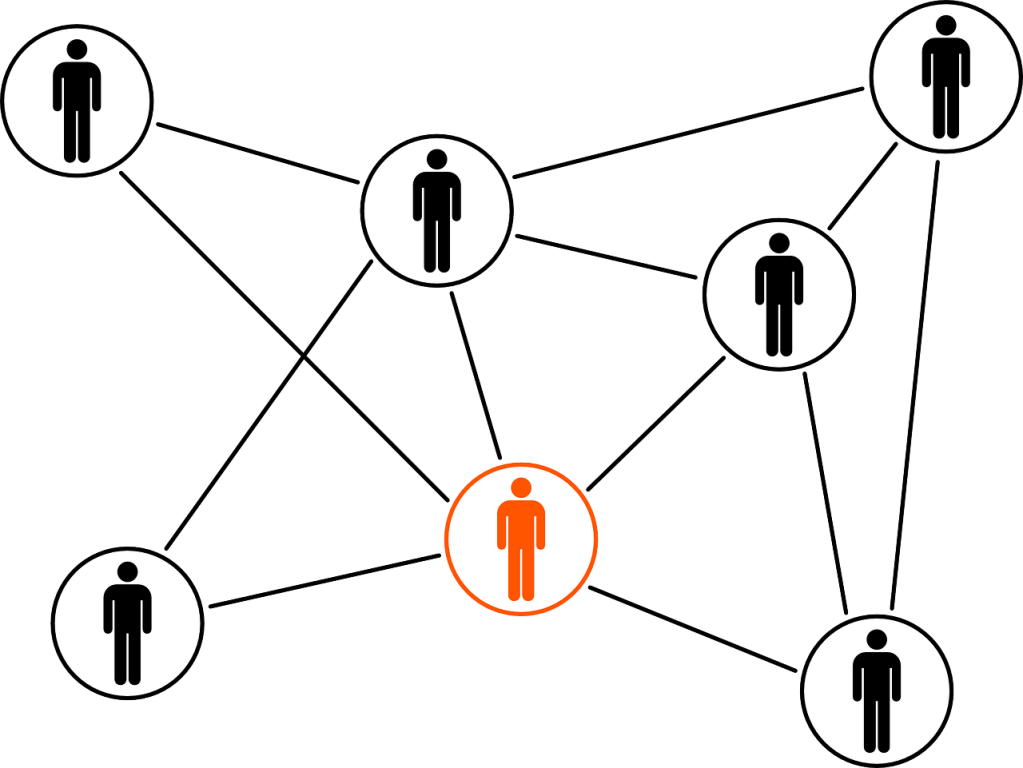
It seems to be a phenomenon of modern life that people don’t connect much in person anymore. Goodbye deep conversations and walks by the riverside. Hello messenger, WhatsApp, reddit, Instagram. You can have a great online community which certainly provides satisfaction and respite to many. But is it at the expense of real in person interaction?
Now in lockdown many of us are questioning our friendships, when the people we would normally interact with might disappear into the background and it could be someone that surprises you that becomes a confidante instead. Best friends may not see each other for weeks or months, and relationships become strained as the person you once trusted may not be available anymore when you miss them – or on the contrary, they may become an irritation by missing you more than you them.
Relationships that used to be dependent on in person connections are now heavily dictated by how willing people are to connect virtually.
Does our connectivity mean a distance from real connection?
Loneliness is a disease that kills. Research shows that chronic loneliness increases the odds of an early death as much as obesity. Maintaining connections with other human beings is vital to our wellbeing. While there are differences in how much and what type of interactions an individual might crave, the truth is that humans do not thrive in isolation.
Avoiding loneliness is not just about getting attention – whether it be from online acquaintances or a therapist, one sided relationships will never meet the needs we have for reciprocity.
Apparently we have the peak number of friends by the age of 25, after which the number starts dropping rapidly. Young people seem to have more connections in general. Perhaps at a young age we strive to find others like us, at study, work, hobbies – while we are still finding ourselves we also seek like minded company. But connections do not mean intimacy. Just because you text 20 people over the course of a week does not mean you are not lonely.
As we age, the close circle narrows down to a few key individuals. Perhaps when we know who we are, we also know who is worth surrounding ourselves with.
People in relationships have even less friends – there is evidence that single people have more connections and more fulfilling friendships than those who are coupled up.
We have a built in bias against easily making friends.
Studies show that people are their happiest with 3-5 close friends. It seems a few close individuals might be more important to our happiness that a large trope of flighty ones. It does not take much for us to feel fulfilled in our relationships; just a few quality connections.
While we can all agree that maintaining friendships is important to us, why is making new friends so hard?
Research by John Cacippo (expert on loneliness) suggest that people are reluctant to make new friends, as it is more important for our survival to avoid enemies than to make friends. Cacippo says we have a built in bias against easily making friends for this reason.
It is not easy for us to build trust – where someone may not be an enemy to us in a physical sense, emotionally they may well be. This is why those intimate friendships really are unusual bonds in the larger sense of things, when you consider just how unlikely they are to be formed in the first place.
It’s important to note the difference between objective and perceived isolation. The question is not about whether or not we have connections, but do we feel that we have them. Loneliness is perceived isolation.
Lonely people deal with others cautiously and defensively as they see them as a threat. The other person might leave and add to the pain. We might feel they do not truly value us and are only bound to let us down. This thinking pattern makes the relationship negative and strained – and is a leading factor in why it is so difficult to get rid of loneliness. When a potential confidant is seen as a potential threat, the connection is lost instead.
If you are lonely, you may easily have thoughts like “no one likes me” or “no one will care if I disappear”. You may feel you are better off alone. Happier alone.
Part of that may be true.
Much of that may be wholly untrue.
“What we think we prefer is often counterproductive for us”, Cacippo says. You may feel ok alone when in fact reaching out to someone that moment may be the best thing you could do to your own wellbeing – even if it goes beyond your instinct to stay alone. Loneliness puts you in a state of “survival mode”, where all you are focused on is protecting yourself, when no one else is on your side.
“What we think we prefer is often counterproductive for us.”
John Cacippo, expert on loneliness
Perhaps we can be our enemy in that sense. We might push people away when we actually should stick with it and not let our fears of failure define our relationships.
Loneliness has this trait of making the socially adept feel inadequate. Everyone is socially skilled enough to make friendships and form bonds, but loneliness makes us fundamentally doubt ourselves. It puts the brain in self preservation mode. It makes us ruin our chances of forming new connections and we may fall into anxiety about social situations.
And this is why loneliness is contagious.
Our emotions feed off each other. Happiness spreads like laughter. Loneliness spreads like the flu. You might not see it, but someone you talked to is a bit down. They react to you a bit cold. You start feeling a bit cold towards them. A bit unwanted, too. Soon you start feeling a bit cold the next time someone else reaches out to you. You start shutting them off, too.
Putting two lonely people together will not cure their loneliness, because loneliness is not lack of contact.
The fundamental issue is confusing contact with connection.
Happiness spreads like laughter. Loneliness spreads like the flu.
If you feel vulnerable and unsupported, it is difficult to engage and be empathetic with others. It is difficult to put yourself in a vulnerable position in which others can trust you – a position in which you can form friendships. It is difficult to build supportive connections if you are deeply longing for support yourself.
It is easier to send a cheery text message than to truly talk about how we really are. It is easier to feign friendship than it is to open up and bond. Yet these flighty, superficial friendships might just make you feel even more alone than ever. We say hello, but do we really know each other? Is this someone I can really trust? Do they say “how are you”, then fade back to the way they were before?
Some people are not as bothered by loneliness as others. Some may thrive with a sense of isolation, while others may fall into the depths of despair…
Just as not all who wander are lost, not all who are alone are lonely. The scary thing about loneliness is, it is a silent killer. It may show up somewhere we don’t expect it. Sometimes we may indeed need to reach out beyond our natural instinct of just caring for ourselves, because, fundamentally, we are all happier with some more love, both given and received.
Contact is not connection.
But with no contact, there is no connection either.
This article was originally published on RevelReader: https://revelreader.home.blog/2020/10/09/friends-hard-to-keep-hard-to-make/
 Raw Rebellion